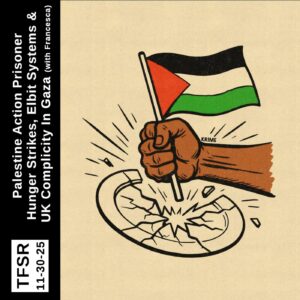
This week, we’re joined by Francesca, a member of Prisoners For Palestine who is a former prisoner herself who speaks about Palestine Action, a group proscribed in the UK as a terrorist organization at the behest of the Israeli state and Israeli arms manufacturer Elbit Systems for their successful direct actions against Elbits war profiteering and the UK’s role in assisting the genocide in Gaza. Currently, 6 incarcerated members of Prisoners For Palestine are on an open-ended hunger strike against their conditions and the continued operation of Elbit which has garnered support from around the world.
This last week, the UK government has begun it’s trial against the 29 Palestine Actionists, simultaneous to the legal challenge to the proscription being brought before the courts. You can keep up on the hunger strikers at PrisonersForPalestine.org and many of the other cases at FiltonActionists.com . Check our show notes for more links.
- Hunger Strikers: Qesser Zuhrah, Amu Gib, Heba Muraisi, Jon Cink, T Hoxha and Kamran Ahmed
- solidarity strikers include: anarchist prisoner Luca “Stecco” Dolce at Sanremo prison in Italy and Dimitris Chatzivasileiadis in Domokos Prison in Greece
- Video of the attack on the Filton warehouse of Elbit Systems where people broke in and destroyed killer drones
- Quite good episode of 12 Rules For What! podcast on the proscription of Palestine Action: https://m.soundcloud.com/12rulesforwhat/106-proscription-and-the-uk-counter-terror-regime-w-iida-kayhko
- Article about concerns of the proscription of Palestine Action: https://www.bbc.com/news/articles/c9vmjjxvj0eo
- A Muslim anti-repression group supporting the hunger strikers: https://www.cage.ngo/
- A group in WNC opposing the local Raytheon subsidiary, Pratt and Whitney: https://rejectraytheonavl.com/who-we-are/
Then, you’ll hear a part of our interview with members of the DFW Support Committee that didn’t make the radio two weeks ago speaking about the application of terrorism charges to antifascists in the US, the wider repression of liberationist movements in the imperial core and the collaboration between far right governments paralleling this.
. … . ..
Featured Track:
- Wein Al Malayeen by Deena Abdelwahed from Nisf Madeena
. … . ..
Transcription
Francesca: My name is Francesca. I’m a spokesperson for Prisoners for Palestine, pronouns she/her. I’m over here in England. We like to say UK, because it makes us sound less racist. But that’s not the case, unfortunately, for a lot of people here. I was in prison for nine months until March this year, held on remand. What that means is you’re held before your trial because, apparently, you’re a danger to the public or something like that. Unfortunately, it’s something that’s being used in a very indiscriminate way over here, just to keep more and more people in prison. I think we’re following a very similar model, unfortunately, to what you guys have over there, which is to keep as many people as possible in prison for no reason at all.
I was imprisoned as a result of a Palestine Action that was my local arms factory just down the road from me here, which makes components for fighter jets and missiles that get sent to Israel, and there’s a lot of them being made over here. While I was in prison, I started writing letters to all the other people who were locked up as a result of alleged direct action. And just to explain a little bit, I don’t know if you have the same concept over there, the term is meant to explain this idea of, instead of just asking the state or the powers that be to do something on our behalf, we go out and do it for ourselves. Obviously, there’s a very long history of people doing this in many different places, in many different times. It’s just that we have this particular term for it right now, which often involves going to these arms factories and causing as much damage as possible and stopping the production of these deadly weapons.
I started writing letters to a lot of the other people who were in prison all around the country, and we formed a bond, which is a bond that I think comes from the particular situation that we’re all in. We’re all in the same boat. We’re suffering from the same repression. That’s quite a unique relationship. I was the only political activist in my prison, and I tried to carry out acts of individual resistance, which obviously is very empowering, but very limited. When I got out of prison, I had heard similar kinds of feelings from the other people who were still in there. And of course, to make this more powerful, it has to be a collective action. I decided to help them by helping them organize across different prisons. And the result of this now is what’s happening, the collective hunger strike.
Six people in prisons around England are on hunger strike at the same time with the same demands within the same campaign. It’s the fourth week now of the hunger strike. None of the demands have been met, but there’s a huge campaign around them, both nationally and internationally, and the pressure is building on the British state to get these demands met. I can tell you about the demands. I’m sure people would want to hear about this.
I think they’re all very reasonable demands that any so-called democracy, which I’m sure we can all agree, we don’t really live in, would automatically give to its citizens. The first one – and that is this is a very simple thing for the prisons themselves to give to the people on hunger strike, but they’ve chosen not to – is no censorship. We’ve seen consistently over the whole time that the hunger strikers have been in prison, and their comrades as well, there’s been a very high level of censorship with the justification, the excuse of security reasons. Because they’re seen as (labeled by the state as) terrorists, they have this excuse of blocking their letters, their phone calls, their visits, their political statements, their general contact with the outside world in a much harsher way than would happen with any other kind of prisoner. Once you express any political opinion, or if you’re in prison for political reasons, then this is what happens. Obviously, prison isolates everybody from the outside world. That’s the whole purpose of it. But this is a more particular repression that’s happening.
We have to fight to get books sent to them, to get letters to them. A lot of the time, we don’t even know if they’ve been received or not. What I can say is there’s already been a couple of wins on this front. Two of the prisoners who aren’t actually on hunger strike, but are comrades of the people on hunger strike, have gotten a massive pile of mail that’s been withheld from them for months now. We can see some reaction from the prison administration on that front.
The second demand is immediate bail for everyone. Not just the people on hunger strike, but all their comrades as well. Because we understand that, of course, not everybody can take part in a hunger strike, but they will not be divided from their comrades. They are doing it on everybody’s behalf. As I said, none of the people who are in prison as a result of this political witch hunt meet the threshold for being held before trial. Apart from that, the legal limit for this in this country is six months. Some of them have been in prison for over a year now, and they don’t even know when they will receive their sentence. They might not even be found guilty, and they won’t get any apology or compensation or anything of the kind if that happens. Their lives are just being ruined for no reason at all. These are young people, mostly of whom haven’t been able to continue their studies at university. They’ve lost their jobs or their houses. They aren’t able to look after their family members. Some of them are sole carers for family members. And they should be able to prepare for their trial out in the community on bail, which is the usual thing to happen.
Number three is the right to a fair trial. Again, something that a supposed democracy should do automatically, but we know that’s not the case, because it is the same people in power who are profiting from arms sales that make these laws. It’s the same judges who make the decisions in court who are in the pocket of these people in power. We don’t really have an independent judiciary. Anyone who’s been before a court will tell you that as common sense. There’s been a lot of slander in the media to prejudice the trial by journalists, but also by government ministers, about the people in prison and about the organization Palestine Action. People already have these ideas in their heads that “they’re violent, that they’re extremists, that they’re funded by Iran.” None of this has any basis in facts, but because it’s been in the mainstream media now, and it’s quite possible that some people on the jury in the trials have seen some of this, they won’t be impartial before they go into that court.
As well as that, it’s very important to talk about the fact that there’s a lot of documents that we’ve seen parts of, they’re heavily redacted, but they’ve been released thanks to lawyers lobbying the government, documents, like emails, meeting minutes that show that the British government has been meeting with Israeli government officials with different state actors, like the attorney general, counter terror police and the CEO of Elbit Systems. Elbit Systems is an Israeli-owned weapons company that operates in the UK as well. It has various factories over here that make drones that are sent over to Israel to murder Palestinian people. We’ve had lots of reports from the people in Palestine about how these are used to massacre the people there. When the action took place in Filton- The reason Filton 24 are called the Filton 24 is that they allegedly went to this factory in the town of Filton, which is in the south of England, and found all these drones that were ready packaged up, ready to be exported to Israel. We can see all these meetings going on behind the scenes, and there are certain things that they say in these documents that Elbit Systems is encouraging the government to put these people in prison without trial, that they’re encouraging the government to come down very hard on them because it’ll affect their business. All these kinds of things, and not all the documents have been released. How can they have a fair trial if they don’t have all that information? They also don’t have all the information about the arms exports by Elbit systems from this country to Israel, which is obviously relevant to their case as well. That’s the third demand.
Number four, and very relevant to what’s happening right now, the wider context (which I can talk a little bit more about later on) is de-prescribing. First of all, I have to explain the word right. In this country, there’s a process whereby we don’t have a constitution like in the USA, which actually protects the right to freedom of expression. That’s being impinged upon in a very, very serious way more and more as time goes on. To proscribe an organization means to designate it as a terrorist organization. And that means, under law, that expressing support for a proscribed or a terrorist organization is illegal, and you can be prosecuted and sent to prison for that. I can give the example of Hamas. Hamas was proscribed as a terrorist organization, and now anyone who says something positive about them can be prosecuted. This has been happening a lot in the last couple of years during this genocide that people have been arrested, harassed, sent to court as a result of doing speeches or chants at protests, even just the word “resistance.” We have a comrade in London who’s a student who’s now being prosecuted for using the word “resistance” in a speech. This is just one example of how the pro-Palestine movement is being repressed, but the people in prison right now are on the sharp end of this, obviously, because they were accused of terrorism before the organisation Palestine Action was designated as a terrorist organisation. That happened in July of this year, but at that point, some of our comrades had already been in prison for almost a year. We can see this gradual, creeping effect that is being orchestrated by the government at the behest of these companies and of the Israel lobby.
To de-proscribe Palestine Action as a terrorist organization would obviously have implications for the people in prison right now, because it would just stop the government from using this as a justification to charge them under terrorism legislation as well. You can see it’s all linked together.
We also demand an apology from the Home Secretary, who’s called Yvette Cooper, an apology for everything that she said, because it was she who was responsible for this change of the law, for this act of calling all of us terrorists. A result of this now is beyond the people that are in prison, who are, as our comrade T put it, who’s on hunger strike right now, they’re the punching bags of this proscription. All of us have had these periods of time where we are going to bed at night and thinking, “Are they going to come for us next? They could burst into our houses with guns at any point in time and drag us off, kidnap us, accuse us of terrorism, and not allow us any contact with the outside world.” That’s what happened to the people who got arrested. They weren’t allowed any contact with the outside world for a week, interrogated day and night by terrorism police. I think it’s quite similar to what’s happening with ICE over there in the USA, actually, that people are just being snatched off the streets or from their houses.
Demand number five, and I think this is the most important demand for everybody who’s on hunger strike. They will say it over and over to us to make sure we don’t forget. And this is directed to the general public, not really at the British state. This is to shut Elbit down. These actions that have been taking place over the last few years by Palestine Action to shut down these arms factories, specifically Elbit Systems, were very effective. There are already four sites in this country that were shut down as a result of these actions over the last five years. And it was clear that that would continue to happen if these actions were allowed to continue. That’s why the whole organization got banned effectively. The people in prison say to us, “We can’t do anything now about this. We’re locked up in a tiny prison cell. All we can do is a hunger strike. That’s all that’s left to us. But you’re still out there. You can still do it. Take action on our behalf, continue our legacy. Keep taking action at these factories. Get them all shut down.” That is the most important demand.
TFSR: Great. Thank you for breaking those down. As I understand, the hunger strike that’s been declared is an indefinite hunger strike, right? It’s not like it’ll go until a certain period of time has passed. This means that there’s a very high likelihood and, as I understand, there’s already been signs of people having faltering health or increased health issues related to it. I guess, before we get deeper into the story of the Filton action and Elbit and such, could you talk a little bit about the condition of the folks who are on hunger strike right now?
Francesca: Yeah, of course. The hunger strike started on November 2. That’s the commemoration of Balfour Day, which I’m sure you’ll ask me about later. It was very important to start it on that date, specifically because of where we are in the role this country has played in the colonization of Palestine from the very beginning. That means now we’re in the fourth week of the hunger strike. Of course, four weeks without taking any calories is a very, very long time, and people’s health has deteriorated quite seriously. Now everybody’s quite weak, dizzy, they can’t sleep, they can’t stand up for a long time. They can’t concentrate. Their memories are deteriorating very seriously. There’s already been one person hospitalized just a few days ago, that’s Cameron. He’s been in a hospital for three days now, I think. He’s still not been allowed a phone call to either his family or his lawyer. Again, the prison is not following its own regulations. We don’t know how he is or anything like that, but obviously, the fact that he’s in the hospital means he’s in quite a serious health situation.
I have to say that the important thing that we want people to know is that one thing that actually improves their health, that gives them physical strength to keep going, is all the solidarity that they receive from around the world. And they’ve had an incredible amount of solidarity. We’ve had messages from everywhere, from Palestine to New Zealand to the USA to the Philippines, and everywhere in between. And every time they get one of those messages, they start to feel a little bit physically better. Same as when we did demos outside seven different prisons on the same weekend, and we got back the messages from all of them that all of a sudden, they could stand up for a bit longer, they felt a bit stronger. I think that’s the important thing to remember. And they are determined and single-minded about this, the reasons and the method of hunger striking. That’s why they’re still going now.
TFSR: Could you talk a little bit about what Prisoners for Palestine is? You mentioned that there are six prisoners who are on hunger strike. And you also mentioned Filton 24. How do those relate? Are all of the six who are on hunger strike members of that, or are any of them Brize Norton Five prisoners? What is the collective?
Francesca: The Filton 24 campaign already existed for quite some time before Prisoners for Palestine started. Well, first of all, there was the Filton 6, and then it was the Filton 18, and then it was the Filton 24. The witch hunt continued for quite some time to include many people that weren’t even at the action on that day. I don’t know how they managed to find many people to arrest for this action.
And now it’s the Filton 23. Something very interesting happened. One of our comrades, Sean, managed to get away. He got bail for a short period of time to attend a family wedding, which is very unusual. I’ve never heard of that happening before. And now, as he put it in his own words, he refused to hand himself in to continue to be a prisoner of war for the Israeli state, which is effectively what’s happened. He’s just being sensible and taking liberty into his own hands. That’s a continuation of the same way of thinking of direct action. We don’t wait for anybody to give us what we need. We take it for ourselves. He’s out there somewhere, we don’t know where, and we are wishing that that continues, that his liberty continues.
The people on hunger strike, some of them are part of the Filton 24 or 23. Two of them are from the Brize Norton Five. This was a different action. And this action was directly afterwards. This was when the proscription of Palestine Action actually happened. We can say it was the most immediate trigger of the proscription of the changing law, but it wasn’t the reason. We know for a fact that the government was planning this for months and months. They were just waiting for the moment, and this was the perfect moment for them, because it was an action at an RAF base, the British-
TFSR: Not the Red Army Faction, but the Air Force?
Francesca: I was just thinking of Top Gun for some reason. Yeah, the British Air Force. This was an action in which some people allegedly broke into an Air Force base where there are lots of huge aircraft that are actually being used, and this came out not too long ago, as spy planes to fly over Gaza and send this information to Israel in real time, and that’s happening on a daily basis. Of course, this was a huge controversy. When it came out, the government tried to deny it, but then the evidence came out, and they couldn’t deny it any longer. And then there was this action at this air base to put two of these aircraft out of service by spraying red paint into the propellers. After that, five people got arrested, and it was in the town of Brize Norton. That’s why it’s called the Brize Norton Five. And two of those people are now on hunger strike. That’s Amu and John. Although they have different names to them, because they’re different cases. They’re all comrades, obviously, and all alleged Palestine Action activists. And they will stand together in this hunger strike, and they also stand together with all their comrades who are on trial at the moment.
TFSR: Just to go back to the actual charges around the Filton case. I think you said there were six people initially who were arrested, and then they started expanding the net and getting more people in there. People had gone to an Elbit warehouse or a factory in Filton and found drones that were being packaged and ready for export, for use in Gaza or by Israel. You would think with charges of terrorism, that they were accused of planting a bomb at the space, or killing security guards, or something like that. What are they actually accused of?
Francesca: It’s very similar to the charges in my case and to everyone else who had taken action at these factories. They relate to property damage. And the problem is now – and this has been happening for over 20 years now – the British government has widened the definition of terrorism to a point that it means anything that they want it to mean. Terrorism has always been a term that has been used in a very racist manner, both here and in the USA. We can think back to 911 and the invasion of Iraq at that time. Anyone who is seen as a threat by the state, in the sense that they dissent, can now be labeled as a terrorist. It’s just been getting worse and worse over this period of time, from the early 2000s. The government lawyers were actually arguing this week in the legal challenge again, it’s a proscription of Palestine Action, that property damage is terrorism. That’s the point we’re at now.
As an extension of that, saying that you support someone who takes direct action, or doing property damage, just saying that is also terrorism. During this legal challenge this week, we had lots of people from a group called Defend Our Juries who sat outside the court with signs saying that they support this, and they all got arrested under terrorism charges. They now have over 2,500 people who have been charged with this over the last couple of months. They’ve been doing a huge campaign of civil disobedience, which has really brought it to light to the general public how absurd this is and how far they’ve taken it in this authoritarian manner. It’s a chain effect, really, from the people who do the property damage to the people who support the property damage. More and more, they are criminalizing as many people as possible just because they disagree with their participation in the genocide in Gaza.
TFSR: And the group Palestine Action has been brought up a few times, and that’s who the proscription is technically against, and the banner that all these people are being threatened under. Can you talk about some of the history of Palestine Action? When the group was founded, the agreements or positions that the group takes, if it’s hierarchical, if it’s a network, how does that work?
Francesca: Palestine Action started five years ago by two people. One of them, Huda, is actually a Palestinian. What they’ve done is taken inspiration from different groups of people who have done similar things. I can talk about the Raytheon 9. That was nine people in Ireland who decided to go and do something at their local arms factory. This was a while back. I don’t remember the year, maybe 15 years ago. And they’re actually coming out in support of us now, which is great. They broke into their local arms factory, caused lots of damage, occupied the place, and managed to get it shut down permanently. Seeing those kind of things and how effective they can be, that was where the idea germinated. And from then on, it just grew and grew just from a couple of people. Now there’s so many people who’ve taken action and on many occasions, they’ve actually been acquitted in court, because there is the legal defense and the prime minister who of this country, who is actually supposedly a human rights lawyer, has defended people in these cases in the past, and used the same legal defense, which is, if you’re acting to prevent a greater harm, then you’re not guilty of property damage. If I smash up a drone to stop that drone from being used to murder people, then I’m not guilty of property damage. A lot of people have been acquitted in this sense. And of course, the government wouldn’t accept that, because it would affect the profits of their friends over these arms companies.
That’s how that started, and it just snowballed from there. And the proscription actually has had a really counterproductive effect, because nobody, only activists, really knew about them before. They went viral on social media because it was very impactful to see how they did the actions, how they occupied the roof with their red jumpsuits, with their fire extinguishers, spraying those all over buildings. But with the proscription, with this legal nonsense that the government’s currently doing, it’s now become a household name. Now, any man on the street, any woman on the street, any person on the street, knows who Palestine Action is. It’s been really effective in a very short space of time, actually. I think the important principle of groups like this is that we can be autonomous. It’s not complicated. Anyone can go out there and do something like this. You don’t need a lot of resources or anything very complicated. It’s just the motivation, the necessity of going out to do something physical with your hands to stop these arms exports, to stop the genocide, because we know that just talking about it or just going to protest about it is not enough.
TFSR: You mentioned, with the Irish case, Raytheon being the arms manufacturer, in that instance, that people were protesting. Just as a note, outside of Asheville, there is a subsidiary of Raytheon manufacturing plant called Pratt and Whitney, and there’s a group that organizes locally, protests about them, called Reject Raytheon. But Elbit has been the company that’s been brought up over and over again in this case. Could you talk about Elbit Systems, its relationship to the government, some of its history, what it makes, and what profits it sees?
Francesca: I think what has to be understood is that Elbit is not just some company that’s making these things and making their profit and leaving it at that. They have a very, very close relationship with the British government, and have had hundreds of millions of pounds of contracts with the British government for various different kinds of technology over the years. And the big thing that we need to talk about right now is that they are trying to get, they were about to get a two-billion-pound contract with the British army to actually train 60,000 British soldiers a year. This was a new low in these relations, because it would become an intrinsic part of the British army. We can see these relationships coming closer and closer, and it’s part of what Elbit themselves say, that their weapons are battle-tested on Palestinians, so later on, they can be exported around the world.
It’s clear to most people that Palestine is a testing ground for all these horrific new weapons, like white phosphorus, for example, which is illegal under international law. Now we can see exploding cell phones being sold during the supposed ceasefire, like the pagers that exploded. All these new technologies, AI being used, facial recognition being used, these drones that are quite new models, that have these capabilities that we haven’t seen before. All of this is really advancing this idea, this dystopian idea of a virtual war. Soldiers almost don’t have to go into the battlefield now. They just do it with a remote from the comfort of their own barracks or wherever they may be. Because when they do actually go into battle, they often lose. We’ve all heard these stories of them running scared from the fighters in Gaza, of them wearing nappies because they’re so frightened that they actually soil themselves. They just sit in their barracks, they remote-control these things, and it completely changes the face of modern war, and it’s terrifying. And they’re pushing this out now from Gaza to the rest of the world through these partnerships, not just with the British Army, but with lots of other countries as well. Just this week, there was an official diplomatic trip by representatives of armies from various countries to Israel to, as they put it, learn lessons from this war. This is why people are passionate about fighting against what is happening in Palestine, not just for the Palestinian people, of course, but because there is this understanding that they’ll do it to everybody else later, and that’s what they’re working on right now.
TFSR: Okay, you mentioned Balfour Day as the initiation date for the hunger strike, and to hear Zionists at least talk about the Israel-Palestine conflict, or the settler colonialism that’s been expanding. It would sound like it is a historic point of difference between a religious conflict between two peoples that has lasted as long as at least David and Goliath. But there are historical points that you can point to when this conflict changed, or when this conflict began. I wonder if you could talk a bit about the UK’s role in the colonization of Palestine and its relationship to Israel up till today.
Francesca: As we can see historically and currently, with many other colonial conflicts around the world, religion is used as a weapon to divide and oppress people. We can see that in the history of Ireland, for example, with the Catholics and the Protestants. But it’s not the root cause of this, absolutely not. That’s why there are many Christian Zionists as well. This is not really, when we come down to it, about religion. It’s about colonialism, it’s about power, it’s about the exploitation of the people who have always lived on that land.
British history is key to understanding everything that’s going on right now. Palestine was British-mandated. Palestine, before it became Israel, it was part of the British Empire for quite some time, and because they felt that they were the owners of that land, just like they felt they were owners of half the planet at that time, they felt that they could gift that to some other people (the also historically oppressed Jewish people) who they were very conveniently trying to get out of Europe because of everything else that was going on there as well. So the Balfour Declaration was signed by Lord Balfour in 1917. For the first time, in an official diplomatic document, it recognized the right of Israel to exist and gifted the land of Palestine to them. Obviously, it had been discussed for quite some time before that by these diplomats, colonial powers, but it was the first time that that was enshrined in an official document and that was the beginning of this process by which Israel came to exist with the official backing of these colonial powers.
From then right until now, we can see that Israel wouldn’t be allowed to exist if it weren’t for the support of these colonial powers. First of all, Britain, then, of course, the USA, but European countries in general which may be, to a more or less extent, now trying to distance themselves from this, just for their own good publicity because their citizens are against this. Of course, the USA is absolutely not distancing itself. Neither is Britain, because it continues with its arms exports. As a result of this, with our understanding of our history that we are in the belly of the beast, as they say, it is our duty as the unwitting benefactors of colonialism to act against this oppression, this tyranny. We are the best place and people to do it. If it’s being made right here, then we’re the ones to stop it. We’re the ones to use our privilege. Because the fact is, despite the fact that we may get locked up in prison, accused of terrorism, et cetera, et cetera, we’re still very privileged compared to the people in Palestine, the Palestinian prisoners, and lots of other people around the world who are victims of these colonial powers.
TFSR: I want to touch on the other groups that were proscribed at the same time as Palestine Action. Because we’re on a roll with talking about resistance to colonialism and supporting decolonial struggles, notably, longtime human rights and social justice activist Irish republican and former MP Bernadette Devlin McAliskey put out a statement in support of the hunger strikes. Can you talk about the weight and legacy of hunger strikes in the UK, as relates to anti-colonial activity and solidarity?
Francesca: First of all, very important for me to say, and this is part of our own political education as well, of decolonializing our language, that the North of Ireland should not be part of the UK. This was invented by the British state. They occupied Ireland. Ireland managed to win its independence, but not the entire island. That is still a settler colonial project that hasn’t been resolved despite the peace process, and there’s still a lot of violence being enacted by the state over there, which people may know more or less about. I try to avoid using the term UK for that exact reason.
When we talk about the biggest hunger strike in this country since 1981, that was the big, famous hunger strike by the H-Block men, IRA people, and Bobby Sands famously died during that. That wasn’t actually in this country; that was in the north of Ireland. Situating ourselves in that political history is really important. The people in Ireland have been incredibly supportive throughout this hunger strike, and it has been a very marked difference from what I can see in the kind of support, the level of support that they have offered to us compared to the people in Britain, and why that is obviously, is because they remember their own history, and they keep that alive, and they understand the seriousness of a situation like this, where people are taking a drastic last resort of going on hunger strike. They will do everything they can to fight for those people, because they’ve lived through that trauma themselves, and they don’t want it to happen to anyone else.
So Bernadette has come out and shared a statement with us, which is absolutely beautiful. When the prisoners heard about that it left them very touched as well. She’ll continue to support us, of course, and she’s always been an example for us in the political sense, never compromising on her radical beliefs. I think that support is what really gives our campaign life and gives it a political grounding, as well as all the other international solidarity.
TFSR: Just to jump back to the proscription really quickly, I’ve seen it described in some articles that the Palestine Action being included in this was snuck in alongside two notorious ethno-nationalist groupings that were also proscribed at the same time. Do you want to talk about that at all?
Francesca: Yeah, I don’t actually remember the names of either of those groups. I just remember the Maniacs Murder Cult because it’s quite a striking name, and I don’t actually know anything about them. I don’t think anybody did really. It was very niche information, as far as I can see. But obviously, the fact that they put this group alongside another group, I’m sure you can tell me better…
TFSR: The Russian Imperial Movement is an ethno-nationalist Russian chauvanist organization that has existed for a couple of decades in Russia, and is very anti-Roma, anti-semitic, and such.
Francesca: Yes. What I can say about both of these groups is that they are in other countries, and this whole process of designating a political group as a terrorist organization has always happened with groups in other countries. And this is the first time that a domestic group, and especially a domestic protest group, has been included in this process. Obviously putting that alongside these other two groups was a very sneaky tactic by the British government to make it almost impossible for MPs to veto that, and that’s what happened. It was only thanks to our campaigning in the period coming up to that vote that some of the members of parliament actually voted against it. A lot of them weren’t even aware of what was going on because Palestine Action was a grassroots organisation. We never dealt with these people in power because it wasn’t part of our strategy or tactics. They didn’t really know what was going on until it was too late. In fact, it came out later that quite a few of them felt that they’d been tricked into this when they were told about what was actually going on. But by then it was too late, obviously.
TFSR: I want to say there have been some white nationalist groups in the UK that have been proscribed. (National Action, proscribed in 2016)
Francesca: Oh yeah, that’s from a really long time ago.
TFSR: But, as you say, it’s putting Palestine Action in the orbit of Nazi groups. There was an international day of action on Tuesday, November 25, for the hunger strikers and their demands. I wonder how this went, and how the UK government has been responding to the hunger strike.
Francesca: Yes, we called an International Day of Action. But what we’ve been seeing in this campaign is that, of course, our hunger strike is a very fast-moving campaign. Things are changing all the time and it’s very organic. We can see from the support we’ve had from many places that people are really taking this as their own campaign, as something that’s important to them, not because we are organizing things on specific days. That’s beautiful, obviously. We called this day of action about two days before, which is obviously no time at all to organize anything. I think there were a few things outside different embassies, actually, some in the Philippines, maybe even Boston. I’ll get the proper update later on. But I think it’s more organic than that, people are just organizing things in their own way on their own time. Because, of course, everywhere has different times and ways of doing things, but I just think generally that international solidarity is constant and ongoing and escalating over time as well, which is really an amazing thing and again, gives a lot of strength to the people on hunger strike.
As for the British government, as expected, no response from them. It’s no great surprise to us. And in fact, when we gave our demands to the British state, we weren’t expecting a response from them. What we were expecting, and what is happening is that the people are mobilizing to pressure them from the grassroots up, and that’s how we will get our demands.
What’s been very interesting to see in the last few days is that we got a couple of letters from left-wing, independent MPs demanding that the government respond. But to me, the most interesting thing is just a couple of days ago, the District Council in Derry, which is on the border between the north of Ireland and the Republic of Ireland, and has been a historical place of conflict for that reason, passed a motion to support the hunger strikers, to oppose the proscription of Palestine Action and to send a cross party delegation to meet with the prisoners’ representatives and their families. This means now that this motion will be passed to every single local council in the country, in the UK (as they call it) and now we can start pressuring those local councils to debate this and to pass it. This is the reaction that we’ve had from the British state, which interestingly enough comes from those dissidents who were ex-hunger strikers and now have those positions within the institutions. Even despite it coming from an institution, really, it’s coming from the people.
TFSR: The first trial group, as I understand, of the Filton case began this week. What is that looking like, and what support are you seeing?
Francesca: It’s been quite interesting. It’s not a coincidence that the prosecution in this case asked for the trial to start specifically at the same time as the legal challenge to the proscription. Why is that? Because once again, they can come out and slander all the defendants in the mainstream media, accuse them of being violent, and therefore, at the same time, try to discredit the legal challenge to the proscription. It seems like that’s not been very effective from their side. We shall wait and see. It’s obvious to everybody that there’s not going to be a fair trial at all. It’s obvious to us that they’re trying to stitch us up on all fronts. That’s why they changed the judge last minute on the legal challenge to the proscription from a judge called Judge Chamberlain, who’s known to be very fair and impartial, to a panel of three judges, two of whom have well-known links to Zionism, funding right-wing political parties, etc. The results of that won’t be known for another month or two, at least, I think.
But as usual, as anyone who’s been through the so-called justice system will tell you, we don’t have faith in these courts, in these legal systems, because it’s the same people that run them that are friends with the people who run the arms factories, the ones that put people in prison in the first place. So we have to do things our own way and not take for granted that we will get any justice from the courts. The Filton campaign has been hugely successful, continues to be hugely successful, and we work alongside them, obviously, as some of the Filton 24 are also on hunger strike. They have people mobilizing outside the court every week. They have mass support. Now they’ve had a year to organize this campaign. The name Filton 24 is on everybody’s lips up and down the country. So, a great example of how to run a successful campaign, I think, and it’s run with the friends and the family of the prisoners front and center which is an amazing thing, really.
TFSR: How can people learn more about the cases and offer solidarity with the six and with the wider trial group, and where are some good places that they can keep up on what’s going on?
Francesca: We have the Filton 24 social media on Instagram. We also have the Prisoners for Palestine social media. Of course, they have a different focus. The Filton 24 page is more focused on the trial at the moment, and Prisoners for Palestine is more focused on the hunger strike. We also have a website for people who don’t use social media. Everything is on there, all the news, updates, and call-outs when we have specific actions that need doing. Of course, it’s different being in another country, different ways to support, not being in Britain.
One thing that everyone can do, and I think this is a great help (not just for the morale of the prisoners, but also to break through this prison censorship, which is one of the demands) is to write letters to the prisoners. It’s a really nice thing to do, especially if you do it in your community. Lots of people do community events where you all write letters together. It may cost a little bit more in postage from over there, but it’s well worth doing. What we’re also focusing on is pressuring British embassies and consulates from different countries. When they see that this campaign has international support, it really freaks them out, because they can see that this is not just a small group of people over here making a fuss about nothing.
I can give you an example. Our comrade T is on hunger strike right now. She actually did a hunger strike back in August as well. Incredible to see the strength behind that. At certain points during that hunger strike, we did call outs for phone blockades to the prison. And the fact that there were people calling with different accents from different countries during that phone blockade really scared the prison administration, as in, “Why are people calling from different countries about you? Why are you popular?” This means that these actions are much more effective, actually. These call-outs, we don’t say ring the prison all the time. It’s much more effective when it’s targeted. It’s just a case of checking out our website or our social media and keeping an eye on that.
The visibility thing is really, really important. There’s no point in doing a hunger strike if nobody hears about it. Just telling everybody in your local community about what’s going on. We have lots of resources on our website that people can use to print out and share. There are really some different things that people can do, depending on what their inclination is and how much time they have available, and where they are as well, because, of course, there’s not a consulate or an embassy in every town.
TFSR: And of note, I think also, as far as international solidarity that was offered during the earlier hunger strike that T was running, at least Casey Goonan and Malik Muhammed are two prisoners that I’m familiar with, two anarchist prisoners in the US, who participated in solidarity, took their own hunger strike and announced it through their support committees, which is really inspiring.
Francesca: Absolutely, and currently, there is an Italian anarchist prisoner, Steco, who’s on a solidarity hunger strike as well, and it’s just been passed to us today, the information that there’s a Greek prisoner who started a solidarity hunger strike. It’s quite incredible to see the amount of solidarity. And I think as time goes on, we’re only seeing more and more of this. Really, really beautiful to see how people can make those connections across borders and across prison walls as well.
TFSR: Yeah, and this is such an international issue that affects so many people in so many places, right as you pointed to throughout this interview, as is pointed to by these prisoners showing solidarity or people calling in. You also pointed that you’re experiencing things by the British government that seem reflective of tendencies of repression happening in the so-called US. I wonder if, in closing, you have any insights from the outside of seeing the application of counterterrorism legal frameworks and tools currently in the US being applied against “Antifa,” but in particular, the case of the Prairieland defendants. I wonder if you could talk about how these states are reacting to opposition to an increasingly violent fascism at home and imperialism abroad in both of these circumstances. What can we teach each other on either side of this ocean?
Francesca: I think it’s a case of looking at the bigger picture, right? We can often get lost in our day-to-day campaigning, because there’s much to do and there’s much going on. But this is something that, to me, is important that we learn from the prisoners, and this is why they’re the locus of our struggle, that when you’re in a place like that, it does give you a different perspective and a different vision. Just the fact that you do have all this time to sit and contemplate and understand things in a different way, just the fact that you are face to face with your oppressors every day. This is something that I’ve experienced as well. You just become so focused, and you just have a different analysis of everything, and that’s really easily lost on the outside world. To take our cues from them, I think, is the key here. And what they show us is that this is all connected. The prison-industrial complex is connected to the military-industrial complex. Colonialism is international, and so the resistance to that must be international as well. The fact that someone in Italy or in Greece can go on hunger strike in solidarity with someone in Britain, despite having never even spoken to them, that’s international solidarity. That is a beautiful thing. And what we can see now is take a step back, we can see the beginning of the end of colonialism, of capitalism. I think it was Gramsci who said ‘the old world is dying, a new one struggles to be born. And now is the time of monsters.’ I think it’s clear to a lot of people that the Israeli state is in a death spiral. It probably won’t exist in a few years. It’s up to us, in the meantime, to keep fighting to make sure that actually becomes a reality. And I think the same with colonialism, the same with capitalism, and what’s going to be born out of that afterwards, that’s what we have to decide, and that’s what we have to work for.
TFSR: That’s a lovely place to end it. Francesca, thank you very much for having this conversation. I really appreciate it.
Francesca: My pleasure. It’s great to talk to you.